

Recent Articles
- Audio 2026 #3: Old Things October 18, 2026
- 2008 System October 11, 2026
- The Federal Reserve’s Nonsense Policy October 6, 2026
- Data on Lynchings, 1882-1968 October 4, 2026
- US Effective Income Tax Rate On Highest Incomes, 1913-2025 September 27, 2026
- Audio 2026 #2: Done September 20, 2026
- What Is “Inflation”? September 12, 2026
- Why Women Do Not Wish the Suffrage (1903) September 6, 2026
- How El Salvador Can Become Singapore West August 7, 2026
- What Replaces Social Security? July 13, 2026
Categories
- "Money Printing" in the 1960s
- Audio
- Basel III
- Build Your Own College
- Economic Issues
- Economic Nationalism
- Full Archive
- Gold Standard Documentary
- Good Money
- How Banks Work
- How Russia Can Go To A Gold Ruble
- NGDP Targeting
- Some Facts About Gun Ownership
- Traditional City/Post-Heroic Materialism
- Understanding Money Mechanics
Audio 2026 #3: Old Things
You probably perceived that my inclinations in Audio tend toward the 1998-2005 period, a formative time when big horns, single-ended DHTs and LM-series Chip Amps were the object of collective attention. Much of what I am doing now is simply realizing my ambitions formed around that time, which is now twenty or more years ago. Didn’t something important or useful happen since then? Is this still the best we can do? Audio Series This era passed basically because of three things: First, the transistor amp manufacturers, embarrassed by the superiority of dirt-cheap Chip Amps, or expensive 300B SETs, actually made some improvements. Second, Class D came on the scene, and has been through three or four generations of improvements since then. Recently, Analog Class D (“pulse wave modulated” or PWM) has been supplemented with what amounts to Digital Class D, in the GanFET “Power DAC” amps. We also now have GanFET linear amplifiers, which are apparently pretty good. Third, big high-efficiency horn systems, even something living-room friendly like a Klipsch Cornwall, didn’t catch on among the general audiophile public. You could have had very small horn-loaded speakers too, like a 6″ coaxial, but people loved the “imaging and soundstage” of their teeny dome tweeters. But when we draw a line under all this, what do we find? We find that Class D has been able to provide enormous amounts of power (commonly 300W+) that’s cheap and also pretty darn good. Maybe not at the highest sound quality levels, but very good value. The same applies to the Power DAC genre of amplifiers. Big power, not too expensive, sound great. I don’t know if they sound better than my $1.58 chip amps, but they should. Conventional Class AB transistor amplifiers got a lot better sounding while still delivering big power. The
2008 System
Here we commemorate my big horn system of 2008, which I’ve mentioned many times. Little of it remains except the picture below. Here are the details: The speakers are: Fostex FT66H bullet tweeterWestern Electric 720A compression drivers (two per side) in a 5′ long folded horn, with about a 110hz cutoff (quarter size mouth)RCA “Ubangi” MI-9462 mid/bass horn, with Altec 515E drivers. This is about a 100hz horn with a full-size mouth.2×15″ Eclipse 8715 subwoofers, in crude car audio boxes Electronics: DIYParadise Monica 3 DAC (battery powered), runs from iTunes on a Mac notebook. Used the TDA1545A, a successor to the TDA1543. Sowter transformer attenuator, 10K:10K. Drives line-level crossover. Amp 1: Welborne Labs Moondog 2A3. 3 watts, on horns. Amp 2: DIYParadise Charlize (battery powered). TA2020 Tripath-based, for RCA woofers. Made about 6 watts into a 16 ohm load. Amp 3: SAE DM-Mark IV. 1980s, 100W solid-state, used with subwoofers Passive line-level crossover on horns, 250hz Butterworth 3rd order. Passive speaker-level crossover (a single cap) on the bullet tweeters, around 5000 hz Active analog crossover on woofers and subwoofers, probably Behringer CX3400. Active parametric equalizer on subwoofers, probably Behringer PEQ305 Audio Series2015 System There were also versions that used my 01A-71A line/headphone amp, to drive the passive crossovers, and a 10Y/45 amp to drive the horns. You can see them on the desk in the picture, to the left. These were powered by a stack of 12V batteries to make 300V, which is in the box on the floor, with an industrial power supply next to it as a charger. This was problematic, since the old and decrepit variable-voltage industrial power supply was unreliable, and batteries need rather precise voltage to charge properly, accurate within a tenth of a volt. I was inspired by two things: First, battery power was
The Federal Reserve’s Nonsense Policy
(This item originally appeared at Forbes.com on October 6, 2026.) It probably seems like the Federal Reserve takes its role very seriously – with a staff of about 800 economists, among a total staff of 24,000. About 400 of these economists report directly to the Board of Governors itself, in Washington DC. We all know that they review dozens if not hundreds of economic indicators, resulting in minutia of policy differentiation that can take the form of a small change in a single sentence. But, I will argue here that all of this central-planning theater is actually just a ridiculous clownshow, proof that even the Best and Brightest (a term I use with full sincerity when referring to Chairman Kevin Warsh, who really is as impressive as anyone could wish for) inevitably descend into bureaucratic idiocy. Recently, we looked at the most basic question, “What Is Inflation?,” a topic that we wrote a whole book about in 2022, because we knew the 400+ economists at the Federal Reserve couldn’t answer this question adequately. We summarized our argument as: Prices go up and down for a lot of reasons, which we can separate into two basic categories: “Non-Monetary” effects, and “Monetary” effects. The “Non-Monetary” effects are everything that might make prices go up and down, within the context of stable currency value. Basically this is supply and demand, and longer-term factors like productivity. Let’s just focus on these “Non-Monetary” factors for now. There is actually a whole school of economics, loosely known as Keynesianism, which does exactly this. Here is Wikipedia’s summary of a giant pile of economic argle-bargle known as “Keynesian economics.” Keynesian economics are the various macroeconomic theories and models of how aggregate demand (total spending in the economy) strongly influences economic output and inflation. To simplify, individual prices can go up
Data on Lynchings, 1882-1968
From time to time I get interested in a topic, and do a little study, mostly on X. Probably I should save some of these for the archives, even if only so I don’t have to look up the same data again later. The usual Race Hustlers would have you believe that people were hanged (“lynched”) simply because of skin color. Are you surprised to find out this is not true? The most comprehensive study of lynching was done by Tuskegee University, covering 1882-1968. They found 4,743 incidents, including 3,446 Blacks and 1,297 Whites. In many Northern and Western States, White lynchings outnumbered Blacks, including: Arizona 31/0California 41/2Idaho 20/0Iowa 17/2Vermont 1/0 https://famous-trials.com/sheriffshipp/1083-lynchingsstte The stated reasons or accusations for lynching were: 41% Felonious Assault19% Rape6% Attempted Rape5% Robbery and Theft2% Insult to White Persons23% Other https://archive.tuskegee.edu/archive/handle/123456789/984?utm_source=chatgpt.com Here is a ChatGPT summary of the stated reasons for the use of vigilante justice, instead of the regular criminal justice system: Here is an interesting graph on White vs. Black Lynchings. https://americanlynchingdata.com/history.html
US Effective Income Tax Rate On Highest Incomes, 1913-2025
Here is a very interesting graph sent by a friend of mine, with full sourcing: Here is a link to the report (by David Ranson) at the Hoover Institute: Hauser’s Law UPDATE: This does not actually measure what I thought it did, which is the effective tax rate on higher incomes, after all the deductions and exemptions. The “effective tax rate” in this chart is merely total Federal tax revenue/GDP, including all payroll taxes. It is still a good message, maybe the most important — namely that higher rates have never led to higher tax revenues, in the US from 1945-present; and that lower rates have never led to lower revenues. Nevertheless, it made me interested in the original question, namely the “effective tax rate” on the highest incomes. “The highest incomes” inevitably includes a lot of one-time members of the 1% club, including inheritances or big capital gains reported from the sale of a house or a company. It’s not just a kind of wage income, such as for a basketball player or a CEO. But let’s see if we can find some info on that statistic. Here is some data from the Tax Foundation: More data is available here. This still doesn’t really capture what I was looking for. Just as you might expect, higher tax rates make the tax base shrink.
Audio 2026 #2: Done
It took a while — six years since I bought the Yorkville U215s used from a dance club in Lower Manhattan — but I finally got around to multiamping them with the LM1875-based “chip amps” that I finished last year. And … It’s fantastic! I was prepared to accept that, after all this effort, maybe the result wouldn’t be much better, or no better at all, than the passive crossovers that Bill Woods designed for these speakers. And indeed I had one speaker multiamped, and the other still with its passive crossovers, both driven by the LM1875 amplifier, side by side, and they didn’t seem that much different. Audio series They didn’t “sound” that much different, because both had the same drivers and cabinets, and both had about a flat frequency response, so why would there be any difference? So I multiamped the other one as well, and did a fair amount of careful adjustment to the crossover and also constant-directivity EQ (all in the digital realm), using a test microphone and Room Equalization Wizard, some free software on my Mac notebook. This additional careful adjusting helped a lot. The result was exactly as I hoped for — a kind of ease and expressive tonality that I remember from every time I multiamped compression drivers in the past, and which was notably missing from the passive version. It’s been 12 years since I’ve had a multiamped horn system up and running, and I think I still like it. In some ways it was almost the same, and in other ways it is so much different, that I would say that it is 3x better. It was not an incremental improvement, it was a huge leap from “Why bother?” to “This is awesome.” If I were to put it on a
What Is “Inflation”?
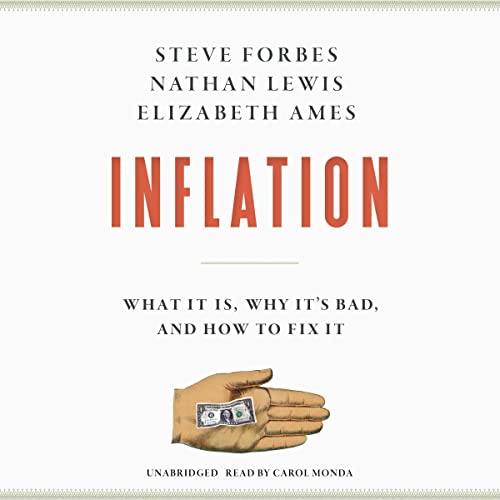
(This item originally appeared at Forbes.com on September 11, 2026.) What is “inflation”? No, seriously, what is it? In our 2022 book, Inflation: What It Is, Why It’s Bad, and How To Fix It, we literally put “what it is” right on the cover, in the title, because we knew that people didn’t know what it is. We were anticipating a deluge of discussion about “inflation”, which happened much as we expected as the official CPI hit +8.98% YoY in June 2022. We expected that even after millions of words on the topic, people still wouldn’t know what “inflation” is. We were right. They still don’t. Most people spend too much time on TikTok. But there are some people, who really are very talented, and really spend hours per day discussing big macro topics including “inflation,” and have been doing so for years and decades. This includes people like Federal Reserve Governor Kevin Warsh, who used to work for bigfoot hedge fund manager Stanley Druckenmiller – who is not only really good, but has been called “The Greatest Macro Investor Of All Time.” So you better believe that Kevin Warsh is also pretty darn good, because otherwise Druckenmiller would have fired him. Although we have a “competence crisis” these days, with people in positions of importance who really shouldn’t be there, this has not been true (yet) at the Federal Reserve. Kevin Warsh is not only competent, but super-competent. It would be difficult for me to name anyone anywhere who brings to the table such a combination of intellectual power, leadership, and real-world experience. I don’t think Kevin Warsh knows what “inflation” is. The hedge fund manager Harris Kupperman, who, like Warsh, has spent decades following the issue of “inflation,” with access to a huge amount of material from top Wall Street economists and
Why Women Do Not Wish the Suffrage (1903)
OK, I admit that it is getting a little too quiet here at Newworldeconomics.com. I have been involved more in government-related issues rather than economic recently, and haven’t posted much about that. So, with many women now going nuts about the Lindsey Clancy business, let’s return to this article in the Atlantic Magazine in 1903. https://www.theatlantic.com/magazine/archive/1903/09/why-women-do-not-wish-the-suffrage/306616 (UPDATE: Since this is behind a paywall, look here at: Why Women Do Not Want the Ballot: Sixty Essays (1904), which includes this Atlantic article as #59.) At that time, Massachusetts was the national hotbed for Feminism and Women’s Suffrage. Early feminism was recollected in Henry James’ 1886 novel The Bostonians, later made into a pretty good movie. Among other things, the novel contains a character who is a practicing woman physician, who is opposed to feminism. The State of Massachusetts, in 1895, surveyed women about whether they wanted to be able to vote. Here’s what happened: Since Henry James brought up the topic of women becoming physicians, let’s take a look at that. Women made up about 6% of physicians in the US in 1900 — a pretty high number, it seems to me. In Boston, it was 19% — in 1900. Of course, most women, then as now, didn’t want to be physicians. They wanted to be mothers, and didn’t have time for this physician business. Those women that did become physicians, I would imagine, were those of a certain masculine cast, that didn’t get married in their 20s. It turns out that women don’t want to be physicians today either. By six years after they complete their residency training, 40% of women have quit full-time work as physicians — compared to 100% of men surveyed still working full time. Of the women still working full time, most of them (68%) were
How El Salvador Can Become Singapore West
(This item originally appeared at Forbes.com on August 7, 2026.) Nayib Bukele, president of El Salvador, is the kind of guy that gets things done. In 1999, then age 18, he established his own advertising company. In 2015, he was Mayor of San Salvador, the capital. In 2017, he was ousted from his political party, the FMLN, and started his own, Nuevas Ideas. In 2019, he became president. He immediately ramped up policing, and in the process, lowered El Salvador’s homicide rate from 38 per 100,000 people in 2019, down to 1.9 in 2024. Pretty impressive. Now what? I propose that El Salvador should try to become as wealthy as Singapore – and the wealthiest country south of the Texas border. But how? Although Bukele’s recent success with policing is a wonderful development, it hasn’t done much for the economy. One way of measuring whether a country is “emerging” or not, is to measure per-capita GDP (in dollars), as a percentage of US per capita GDP. When we do this, we find that El Salvador’s per-capita GDP today is about 6.5% of the US standard – about the same as 1968. At least in relative standing, El Salvador has gone nowhere in sixty years; and there isn’t any evidence that any new trend has started. In 1960, Singapore wasn’t that much better off than El Salvador. The city-state, which was already a key transportation hub, did have a number of advantages inherited from British establishment and rule. But, in 1966, per-capita GDP was only 13.7% of the US figure. Today, it is 110%. When I look at El Salvador’s economic policies, they look … not bad … but ordinary. You won’t achieve extraordinary results with ordinary policies. It hasn’t happened, in the history of El Salvador in the past sixty
What Replaces Social Security?
(This item originally appeared at Forbes.com on July 13, 2026.) The Social Security system might have been a good idea in 1936, when seniors faced the collapse of asset values in the Great Depression — including the devaluation of their bank savings in 1933 – while their adult children were also out of work and struggling to feed their own children. The original tax rate was 1% paid by both employer and employee, or 2.0% combined. It reflected a world in which about 6.3% of the population was over Age 65, compared to 18.9% today, or 22.0% in 2040. It might have been a good idea in 1950, when the ratio of payers to recipients was 16.5:1, and the tax rate had climbed to 3.0% combined. But it is definitely not a good idea in 2026, or for the foreseeable next fifty years. At present, there are about 2.7 workers paying into the system for every beneficiary. By 2035, this is expected to fall to 2.3. The combined payroll tax to pay for this is now 15.30%, not the 3.0% of 1950. But that is not covering the bill. Payroll tax revenue covered 91.2% of expenditures in 2024, and that percentage will go down. The Social Security system itself is drawing on its retirement savings, as it has since 2010. Pretty soon the Social Security retirement savings fund (known as the Social Security Trust Fund) will run out. The Congressional Budget Office now expects this Trust Fund to be depleted by 2032, at which time either taxes will rise or benefits will be cut, by as much as 28%. But this “Trust Fund” is itself something of a figment of Congressional imagination. Basically it is a commitment by the Federal Government to fund Social Security payments. Since the Federal Government